How it works
A kitchen needs a scale, a bin with a lid, and the phones the crew already has. Here's the whole routine.
Who does what
- Crew
- Weighs anything that's about to be thrown out and logs it on the phone. Takes the short training booklets.
- Shift lead
- Reads the one-minute huddle at the start of the shift and tapes the number where everyone can see it.
- Owner or GM
- Sets up the kitchen, keeps the owner key, decides whether to publish, and watches the weekly trend.
What you need
- A digital kitchen scale that reads to 0.05 lb or 1 gram and holds about 30 lb. Around $30.
- A bin with a lid next to the scale, away from prep and food.
- Any phone with a browser. Nothing to install. It saves with no signal and sends later.
- Fifteen minutes to set up the kitchen and tape the crew sign by the scale.
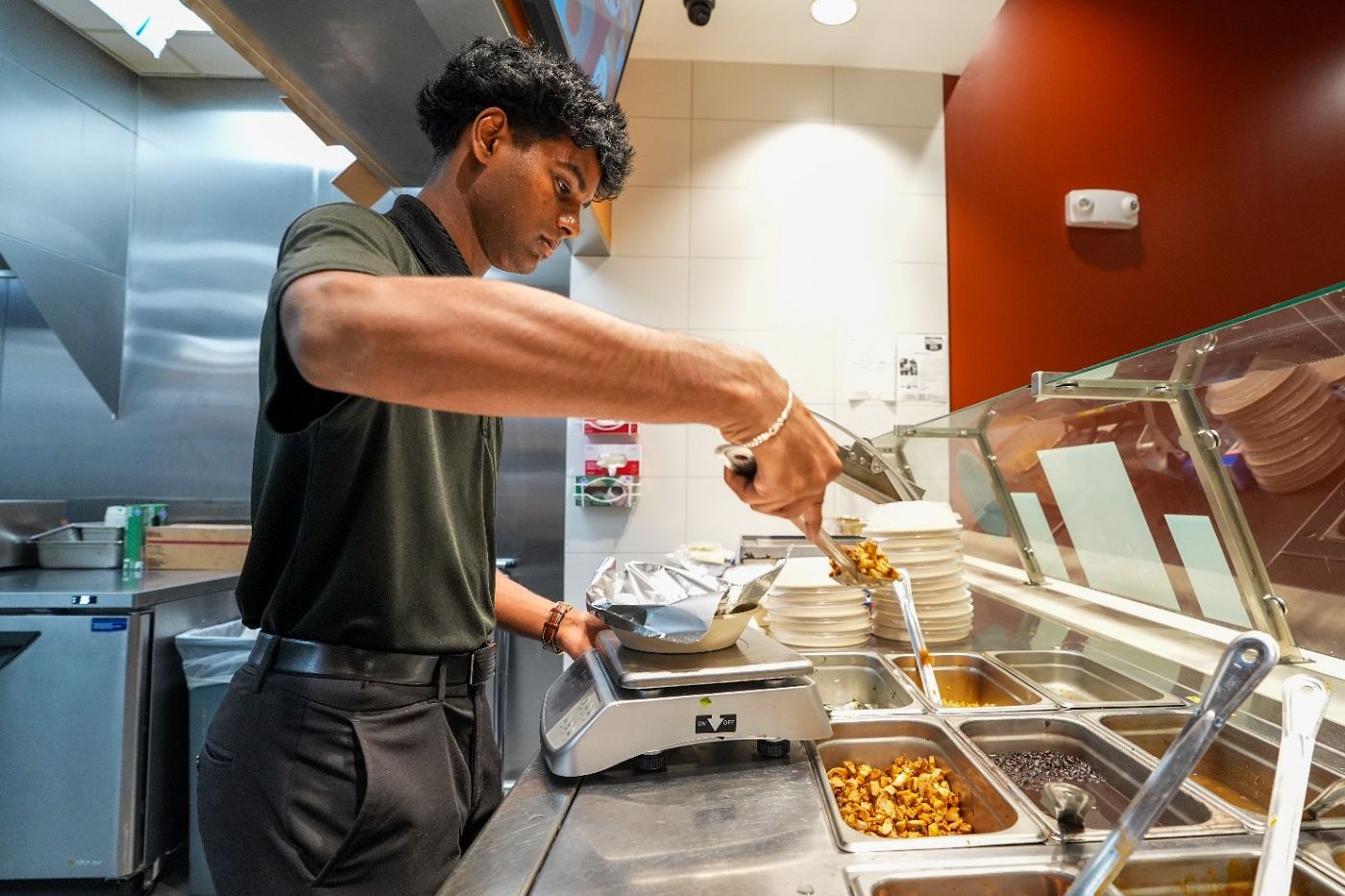
Set it up once
The owner or GM sets up the kitchen: a site code the crew types, a crew PIN, and an owner key that only the owner keeps.
The setting that matters most is expected logs per shift: how many times a normal shift throws food out. Count the end-of-rush pans, the prep trim, the walk-in check. Every number on the kitchen's page is measured against it, so set it before the first weigh and don't change it.
Logging takes about ten seconds
- ATap what it is. Each kitchen has its own list: cilantro lime rice on a burrito line, sambar in a temple kitchen. The most-used items come first, and search finds the rest.
- BPut it on the scale and type what it says, or tap to add. If it's still in a pan, tap the pan and its empty weight comes off.
- CTap why. Six reasons, the same in every kitchen, so kitchens can be compared.
- DSave. If the food was donated or eaten by staff, tap that first so it counts as rescued. It waits on the phone and sends the moment there is signal.
- EThe shift's squares fill as logs come in. Everyone can see what is still missing.
The scale spot
Three rules, every time. They go on the first page of the first training booklet, in all three languages.
- Own spot
- The waste scale has its own place, away from prep and food. It never touches a prep table.
- Lids on
- Waste bins have lids, and the lid goes back on after every weigh.
- Wash hands
- Wash your hands after every weigh, before you touch food again.
The huddle
At the start of every shift, the phone writes a one-minute huddle from last shift's logs: the number, the top reason, and one thing to do differently. It never names anyone.
Read it standing by the scale, then print it and tape it where everyone can see it. When the number drops, it's the whole team's win.
It comes in English, Spanish, and Telugu. When AI is set up on the site, a button can reword it in plainer language with every number kept the same.
Team, last shift we logged 4 of 5 expected weigh-ins and threw out 4.6 pounds. Most of it was rice (2.9 lb) and the top reason was: made too much. That is about 4 meals.
Today: cook rice in smaller batches and check the pan before you start a new one.
One thing, one shift. Let's come in under 4.6.
The first three weeks
- Days 1 to 14
- Weigh only. No huddles, no training, nothing on the wall. This is the baseline: what the kitchen throws out before anything changes.
- Day 15 on
- Huddles every shift, the training booklets, and the number on the wall.
- Day 22 on
- The kitchen's page starts comparing the last 7 logged days with the baseline, with coverage printed next to it. One kitchen with no control group is a case study, and the page says so.
Tools for other kinds of kitchens
A temple serving 150 on a Sunday, a school lunch line, and a food pantry lose food in different places. The crew app has a Tools tab for those. Each kind of kitchen starts with the tools that fit it, and the owner can turn any of them on or off in the Site tab.
- Cook-to number
- Before a recurring meal, it suggests how many to cook for from what you served the last four times, or from reservations and your own show-up rate. It adds 5%, suggests one backup dish instead of extra of everything, and turns the number into a prep list from your quantity sheet. After the meal, enter how many came and what was left, and the prep list learns from it.
- Event mode
- Guest counts, a door counter, a pan sweep at close (full, 3/4, half, or a quarter pan, turned into pounds), bags by stream, and a one-page report for the client or committee.
- Tray scores
- Score a sample of trays by eye in quarters instead of weighing every one. The scorecard shows which items come back most and one fix to try. Audit day walks through a sort-and-weigh audit, and schools get a share table.
- Serving line
- A timer for each pan that goes out, temperature checks, and a verdict when it comes off: whether it can be donated, kept, or has to go. It prints a label and writes the pickup message for a partner like Magic City Harvest or FeedBHM.
- Pantry
- Deliveries in by source, a list of what to hand out first, and a check for past-date, dented, or damaged food. A USDA Foods loss of $100 or more brings up the food bank's checklist.
- Temperatures
- One reading a day for each fridge, freezer, shelf, and hot well, flagged red when it's out of range.
- Forms
- The owner can download monthly drafts of the loss log, meals served, temperature chart, training, production record, and intake, to copy onto the food bank's or state's own form.
Faith kitchens can turn on faith settings: the name of your meal, gentler words like “left over” instead of “wasted,” which foods are blessed, and where blessed food may go. In every kitchen, food that comes back from plates is never donated, sent home, or eaten by staff.
| Kitchen | Tools |
|---|---|
| Restaurant / fast casual | The waste log on its own |
| Faith or community kitchen | Cook-to number, Event mode, Serving line |
| Concession stand | The waste log on its own |
| School cafeteria | Tray scores, Cook-to number, Serving line |
| Event / wedding | Event mode, Cook-to number, Serving line |
| Hotel buffet | Cook-to number, Serving line |
| Soup kitchen / shelter | Cook-to number, Pantry, Temperatures, Serving line |
| Food pantry | Pantry, Temperatures |
| Hospital or care facility | Tray scores, Cook-to number, Temperatures |
| Senior center / Meals on Wheels | Tray scores, Cook-to number, Temperatures |
| Other kitchen | Cook-to number |
The food safety rules come from the FDA Food Code that Alabama enforces, USDA, and the Community Food Bank of Central Alabama. See every source. Your health department has the final say, so check with them before you donate or reuse food.
Training
Four short booklets, about three minutes each, with a three-question quiz at the end. Crews take them on the kitchen phone, and the score is saved without a name. Anyone can read them here.